20 minutes of footage. 37 reels.
Two iPhones, a mother and daughter, and one treatment room. The whole system, including the exact lights and settings.
Everybody wants two things from their content, and they usually think they have to pick one. Quantity or quality.
Quality gets talked about like it means equipment. Better camera, better lights, better mic. That's part of it, and I'll give you every setting I used further down.
But quality really means one thing. Are you making something people actually want to watch?
And that got a lot harder this year.
We're in a trust recession
Making content has never been easier. AI will script it for you, shoot it for you, voice it for you, and post it for you.
So everybody sounds like an expert now.
Which means nobody knows who to believe anymore. That's the recession. Not attention, trust. There's plenty of content and almost no reason to believe any of it.
Here's how that plays out in your world. Somebody six months out of esthetics school is earning the eyeballs and the ears over somebody who's been in the treatment room for twenty years. Not because they're better at the work. Because they're better at the packaging.
Lauren said this to me almost word for word. She owns The Skin Spa & Acne Clinic and her book is full, and she's watched people who are great at making content turn out not to be great at the actual job. She knows because those clients eventually land in her chair with their barrier wrecked, using decent products in completely the wrong way.
She's not wrong. And I don't think the answer is to out-produce them.
Authenticity is what wins now. The problem is that word has been used so lazily for so long that nobody can tell you what it actually means in practice.
So here's what I think it comes down to.
One. You talk about what genuinely lights you up. Not what you think you're supposed to post about. The thing you'd bring up at dinner without being asked.
Two. You speak to another human being, in the same room, not through a lens. The camera is in the corner recording. It isn't the audience. The person in front of you is.
Do those two things and you can't really be faked, because nobody else has your interests and nobody else has that room.
That's exactly what we did here. Twenty minutes of footage. Thirty seven clips worth posting.
The other thing nobody wants to hear
When an esthetician posts a great treatment video, the saves and shares and comments mostly come from other estheticians. Which feels amazing. Your notifications light up, people you respect are loving on your work, and it genuinely is a compliment.
But those people are not booking with you.
What you actually want is a consumer within ten miles of your treatment room. One person, close enough to drive over. That's the whole game.
And it takes longer than a reel. The number I keep hearing is seven to eleven hours of listening to somebody or watching them before you really trust them. I don't know who first measured that, but it matches what I've seen. That's why podcasts work. That's why long form works.
You cannot build that in fifteen seconds, no matter how good the hook is.
So the question I brought into Lauren's room was simple. How do we get somebody to feel like they've had dinner with you four times?
Bottleneck one: knowing what to say
Most people get stuck here and never make it to the camera.
The trap is thinking you need content ideas. You don't. Anybody can open Claude and ask for ninety content ideas about acne. That's free now, and it's worth about what it costs.
Nobody has your set of experiences. Your fingerprints. The way you explain something to a client who's scared about their skin. That's the part that can't be copied.
The mechanism I'd steal is pairing two things that don't normally belong together.
There's a guy I saw who breaks down basketball film. There are a million people doing that. But he does it sitting across from his baby in a high chair, explaining the play to a toddler who has no idea what's happening. Three million views, barely any following.
The basketball isn't the idea. The pairing is.
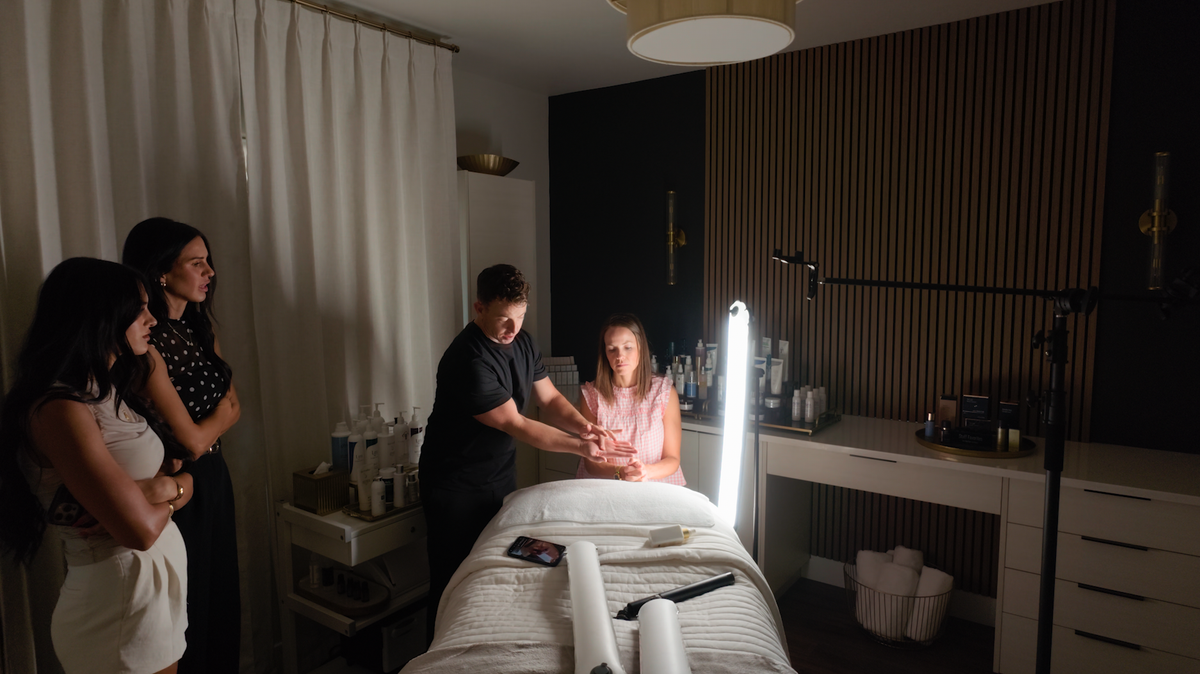
So in Lauren's room, we didn't script anything. She started the facial, Brooklyn was on the table, and they just talked. It went to Hawaii, because Brooklyn had just gotten back and her skin had freaked out from the humidity and her cycle. It went to crime documentaries, because Lauren has apparently watched every Judge Judy in existence and has moved on to other judges.
A facial, and true crime. Two things that don't belong together.
That's the content. Not the ninety ideas.
The version of this you can run forever: pick the person you actually jam with. A client you always laugh with, a friend, your mom. Then think in series. Can I make a hundred of these? Traveling, from the esthetics chair. Restaurant reviews, from the esthetics chair. Once you find the lane that feels sustainable, you stop starting from zero every week.
Bottleneck two: filming it
This is where people spend money they don't need to spend.
We used two iPhones. One boomed directly over the treatment bed on a C stand, pointing straight down at the facial. One on the faces.
That gives you a split screen, and the split screen is what makes it feel like a show instead of a clip.
My number one rule with lighting: turn everything off first.
Kill the overheads. Every one of them. Then add light back in on purpose, one source at a time, and watch what each one does. If you start with the room lights on, you're just decorating someone else's bad lighting.
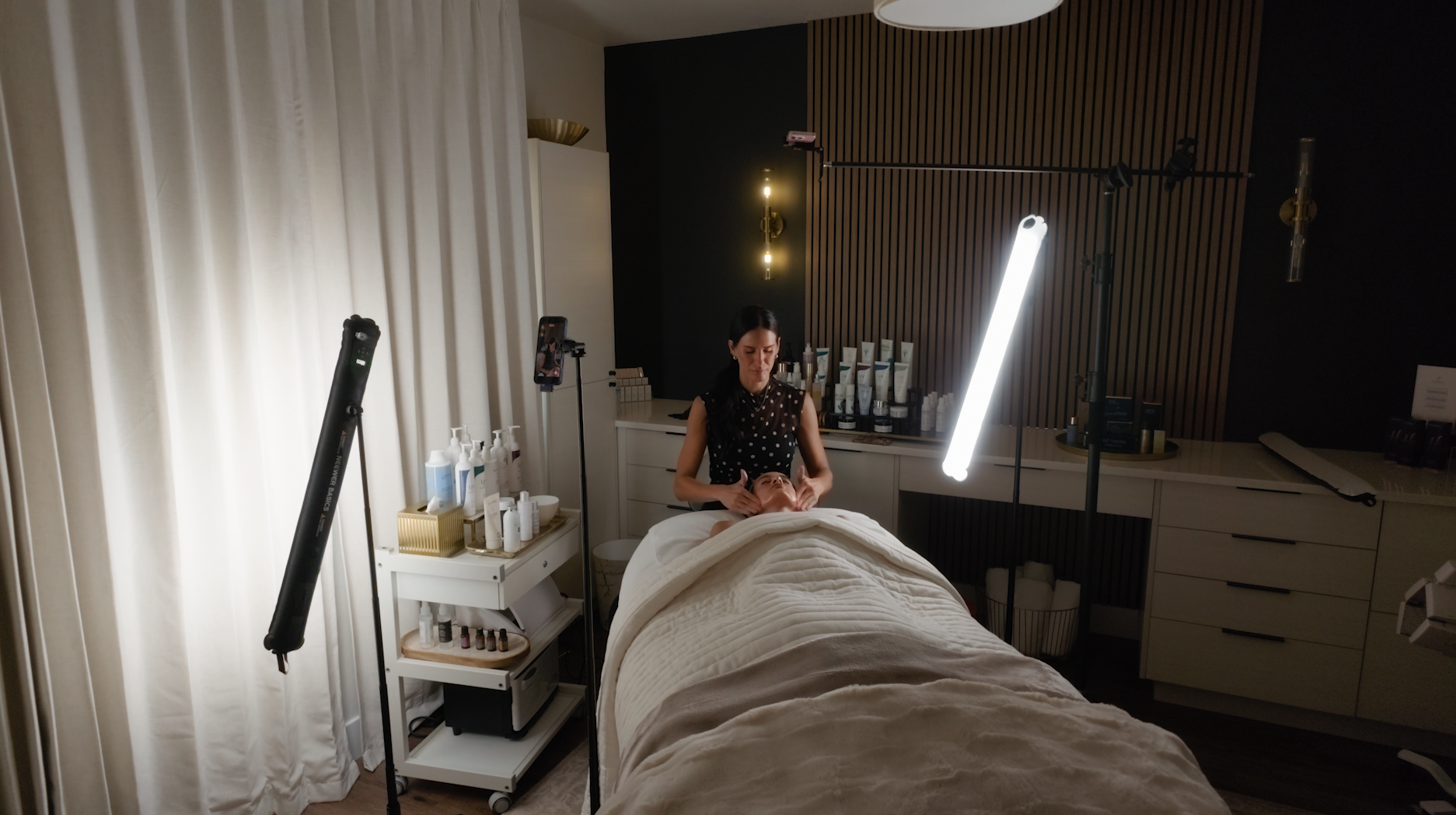
The lights I brought are inflatable tube lights. Fifty to a hundred dollars, closer to a hundred now than when I filmed this. They pack flat, run on battery, have a magnet on the back, and you can dial the color temperature. I take them everywhere.
On color temperature, two numbers are all you need. 5600K is midday daylight, cool and blue. Around 3700K is warm morning light, soft. Whatever accent lighting already exists in the room, match it, or the two will fight and it'll look off in a way you can feel but can't name.
Backlight is the most underrated thing in a small treatment room.
Everybody wants to put the light in front. Put one behind instead. It outlines your subject and separates them from the wall, and suddenly a plain room reads as dimensional. Lauren watched it happen on her own phone screen and said it was crazy, because it is. It's a fifty dollar light doing the work of a set.
Backlight plus slow motion is also the entire secret to those juicy product shots. Serum dripping off fingers, a spray catching the light, texture on a fingertip. Put the light behind it, throw the phone into slow motion, and you're building a bank of b roll you'll use for the next year.
Judge all of this through the phone, not with your eyes. The camera does not see what you see.
iPhone settings, exactly:
4K, 24 frames per second. Enhanced stabilization ON. HDR video OFF.
Shooting 4K means you can crop later. I can punch in two times, straighten a crooked frame, or take a horizontal shot and pull a full vertical reel out of it without losing quality. That single setting is what lets one recording become both a YouTube video and a stack of reels.
Two more that take five seconds and change everything:
Tap the screen to focus, then press and hold to lock it. Now the camera stops hunting mid sentence.
After you tap, drag the little sun icon down. That's your exposure, and it's the difference between blown out and cinematic.
Audio:
I use the DJI Mic Mini and the Hollyland Lark M2. Both clip to a collar and connect straight to a phone. A clip on mic reads far less abrasive than someone holding a stick, which matters a lot when you're trying to make a room feel like a conversation.
One setting people get wrong: leave noise cancelling OFF unless you're genuinely somewhere loud. It strips the body out of your voice. You want buttery. Noise cancelling gives you thin and hollow.
And half seriously: once you get into a rhythm with this, mount a phone in your ceiling. I'm not joking. If you know you're recording an hour a week, stop rebuilding the rig every time.
Bottleneck three: getting it edited
This is where most people quit, and it's the one with a real decision in it.
You have three paths. Pick one, today.
Learn it yourself. CapCut desktop, or Edits by Instagram, which is rolling out a desktop version. Editing on a laptop is dramatically faster than editing on your phone, I promise. Open Claude and say "I'm a beginner at CapCut, here's what I'm trying to make, give me simple instructions." It'll walk you through it.
I use Adobe Premiere Pro. Steeper learning curve, and I'm not going to pretend otherwise. But if you're serious about this being a real part of your business, it's worth considering.
Hire it out. I've paid editors three dollars an hour and I've paid editors five thousand a month. Most of the time you get what you pay for, honestly. The cheap end lives in the Philippines through Fiverr and OnlineJobs.ph, somewhere between three and eleven an hour.
But here's the part that makes hiring actually work, and it's the whole reason the next section matters. An editor who has to make creative decisions is expensive and slow. An editor who's been handed a format, the clips, and the direction is neither. Your job is to become the one who decides. Their job is to cut.
Wait for AI to do it. It's coming, and honestly it's mostly here. I've built a tool that takes the transcript from a shoot and automatically chops the moments in Premiere. Whenever you're reading this, it's further along than it was when I wrote it.
But I'd start now anyway. Because when the tools arrive, the people who've already been filming for six months will be miles ahead of the people who waited for permission.
The part where AI actually earns its keep
You just recorded an hour. You do not remember the good parts. You genuinely don't, and watching it back to find them is the most demoralizing hour of your week.
So don't. Get the transcript instead.
How to get an SRT file for free:
Upload your video to YouTube and set it to Private. Nobody sees it. Go to YouTube Studio, click Subtitles, find the auto generated track, hit duplicate and edit, then the three dots, then download SRT.
That's it. You now have every word you said with a timestamp attached.
An SRT is just the words plus the timing. From 3:31 to 3:34, this is what was said. Which sounds boring until you feed it into Claude, because now it's as if it watched the entire video and can tell you exactly where the good parts are.
I built a skill called facial clip finder that does this.
A skill is just a saved recipe. Instead of re explaining your whole situation every time you open a new chat, the skill already knows the job.
Same instructions in, same quality out. Crack the eggs, mix it, set the oven. You get the same cupcakes on Tuesday that you got on Sunday.
I dropped the facial transcript in. It came back with 37 clips.
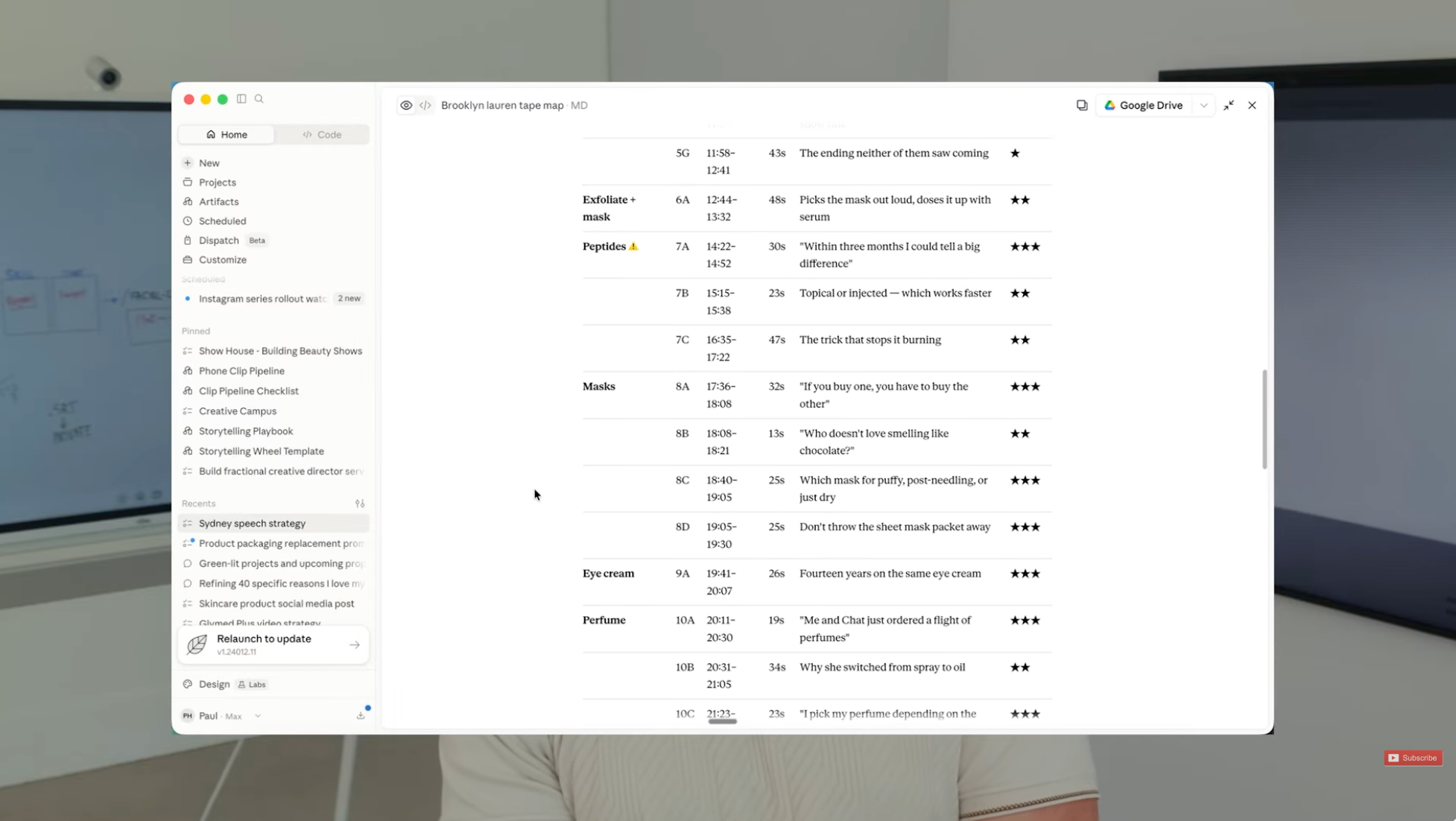
Not a vague list. Each one timestamped, star rated, catalogued with a code so I could reference it later, with a one liner reminding me what happened in it. Then six title and hook options for any clip I pointed at.
One of them was the Hawaii stretch, where Brooklyn talks about her skin freaking out on the trip and which product actually pulled it back. Three stars. That clip exists because two people were chatting about a vacation while one of them did a facial.
It even asked me clarifying questions first. Who was giving the facial, who was receiving, which products were used. I wasn't in the room when they filmed, and it still built the map.
This is also what turns a cheap editor into a good one. You're no longer sending someone an hour of footage and hoping. You're sending them a list of moments, in order, with the text that goes on screen already written.
You can have the Claude skill for free. I've put it here: https://www.paulheslop.com/facialclips
It's free. It asks for your email, because I'd rather send you the next one of these than not. Download it, upload it into Claude, and it works on your footage the same way it worked on theirs.
One more that has nothing to do with facials and will save you more time than anything else on this page: stop typing.
I use Wispr Flow. One button on my laptop and I just talk, and it cleans up my sentence structure on the way in.
I don't type prompts anymore. I don't type most emails anymore.
The gear
Everything we used, nothing else:
- C stand and boom arm, for the overhead angle
- Phone mount for the C stand
- Inflatable tube light
- Phone and light stand
- DJI Mic Mini
- Hollyland Lark M2
The honest version of the timeline
I want to be straight about the numbers, because I've seen people stretch this kind of thing.
I was at the spa for about two hours. In that time I taught them the concept, set up the lights, worked through the strategy, and afterward we sat down together and went through the analysis of what we'd captured.
The footage itself was twenty minutes. That's the part that turned into 37 clips.
The two hours were the teaching. Once you know this, the two hours don't repeat. The twenty minutes do.
What I'd do if I were you
Don't plan it.
Pick the person you already talk easily with. Turn off your overhead lights. Put one cheap light behind them. Boom a phone over the bed, put another on your faces, clip on a mic, and go do the treatment you were going to do anyway.
Then talk about what you were actually going to talk about. Hawaii. A show you're behind on. The trip you're saving for.
That's the whole trick, and it's the reason this beats anything AI can generate for you. A machine can write you a hook. It cannot sit in a room with somebody and be interested in them.
Post before it's perfect. You're not chasing view counts. You're chasing the people within ten miles of your room, and there aren't that many of them, which means you need far less reach than you think.
In a year where everybody can sound like an expert, the only thing left that can't be copied is you, talking to somebody, about something you actually care about.
I write these up after every shoot. If you want them, drop your email below.